Overview

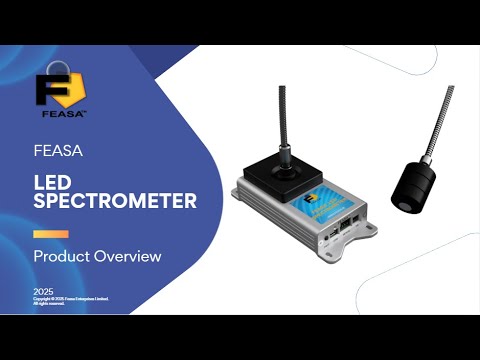
Absolute measurement is essential wherever consistent, traceable LED quality is a production requirement. The Feasa LED Spectrometer was developed specifically for LED manufacturing, providing the reference standard for accurate color and intensity measurement.
Unlike many laboratory spectrometers, it is designed around the practical requirements of LED production, enabling manufacturers to create traceable reference measurements and calibrate production equipment with confidence.
Combining laboratory-grade accuracy with production-ready operation, it provides the traceable reference measurements used to calibrate Feasa LED Analysers and maintain consistent manufacturing quality.

Luminous Flux
Lumen (lm) – Miniature Integrating Sphere
The miniature integrating sphere captures the total light an LED emits in every direction. It sits directly over the LED, so users can simply and easily measure the LED in a 2π geometry.
Used with the Feasa Spectrometer, it allows absolute, traceable measurements of luminous flux and radiant power (W). Spheres cover ranges from 0.01 lm to 10,000 lm, with compact models just 25 mm in diameter. Entrance ports range from 5 mm to 45 mm.

Luminous Intensity
Millicandela (mcd) – Luminous Intensity Head
The luminous intensity head measures how much light an LED emits in a given direction. Used with the Feasa Spectrometer, it allows absolute, traceable measurements of luminous intensity and radiant intensity.
The head complies with CIE Condition B and is available with 2 mm, 4 mm and 8 mm diameter measuring ports. At just 20 mm in diameter, it allows easy access to LEDs on populated PCBs.

Luminance
Candela per square metre (cd/m²) – Luminance Head
The luminance head measures the brightness of a light-emitting surface. Used with the Feasa Spectrometer, it allows absolute, traceable measurements of luminance and radiance.
The head is available with 2 mm, 4 mm and 7 mm measuring areas. At just 12 mm in diameter, it allows easy access to automotive displays, backlit symbols and light guides.

Golden Sample Generation
Make every test fixture traceable
Use the Feasa Spectrometer to create a golden sample: a reference board used to adjust Feasa LED Analysers in production fixtures to traceable, absolute values. First, measure each LED on the board with the spectrometer.
Then place the golden sample in the fixture, and the Feasa software adjusts each LED Analyser channel so its readings match the spectrometer's values. Every fixture on every line can report consistent results, matching the golden board values. Verify any time with the same board.

From the Lab to the Machine
Built for industrial use
The Feasa Spectrometer is not only a lab instrument. It is small, lightweight and robust enough to be built directly into industrial machines, automated test equipment and robotic cells.
At 125 × 54 × 32 mm, it fits where larger instruments cannot. An external trigger input and a daisy-chain bus make it easy to integrate and scale. It can be controlled over USB or RS232 from LabVIEW, C, C++, C# or Python, for high-volume, high-accuracy measurement on the production line.
The reference standard. Trusted globally.

Absolute, traceable measurements
Measure with confidence in photometric and radiometric units, including lumens, candela, cd/m², and watts.

Full spectrum measurement
Measure across the 380–780 nm visible spectrum with high spectral resolution for detailed spectral analysis.

Complete software package
The full Feasa Software Suite is included as standard, with DLL and programming examples for LabVIEW, C, C++, C# and Python.

Flexible system integration
Generate and characterise golden samples for LED Analyser adjustment and validation, or integrate directly into production for high-accuracy automated measurement.

Proven in production
- Millions of LEDs tested every day using Feasa products
- Worldwide usage on production lines by leading manufacturers

Direct engineering support
From fixture integration and setup to troubleshooting, our technical team supports you throughout deployment.
Applications
Where our LED Spectrometer is commonly used.


Technical Specifications
| Parameter | Value | Notes |
|---|---|---|
| Wavelength range | 380–780 nm | |
| Peak wavelength accuracy | ±1 nm | |
| CIE xy accuracy | ±0.005 | |
| Power / Luminous Flux accuracy | 10% | |
| Repeatability — wavelength | ±0.5 nm | |
| Repeatability — CIE xy | ±0.0005 | |
| Intensity repeatability | <1% | |
| Adapters (sphere / intensity / luminance) | SP13/23/16/26 · CD02/04/08 · LU01/02/04/07 | Integrating Sphere = Luminous Flux (Lumens) · Luminous Intensity = Candela (CIE Condition B) · Luminance = cd/m² (automotive displays) |
| Supply voltage | 5.0V | |
| Supply current | 220 mA | |
| Dimensions | 125 × 54 × 32 mm | |
| Fiber diameter | 5 mm | Armoured patch cord |
| Min. bend radius | 35 mm | |
| Operating temperature | 0–50°C | |
| Interface | USB, RS232, Daisy Chain, Ext. Trigger | |
| Compliance | CE, RoHS | |
| Model / order codes | Spectrometer: S2 · Miniature Integrating Spheres: SP13, SP23, SP16, SP26 · Luminous Intensity Adaptors: CD04, CD08 · Luminance Adaptors: LU04, LU07 |
Feasa Spectrometer Software Suite

Included — Windows 11 / 10 / 8 / 7 / Vista / XP
- Graphical Display Program — Real-time full spectrum display and CIE xy chromaticity diagram
- Datalogging and compare — Log measurements over time, compare against stored references
- Terminal & Scripting Program — Command-line control with CSV export
- Feasa Spectrometer Software — Calibration workflow, golden board generation, Analyser value transfer
- Test Software and User Cal — Also included with every unit
- DLL/SDK — Programming examples in LabVIEW, C++, Python
Downloads and Resources

Spectrometer Datasheet
Integrating Spheres Datasheet
Luminance Head Datasheet